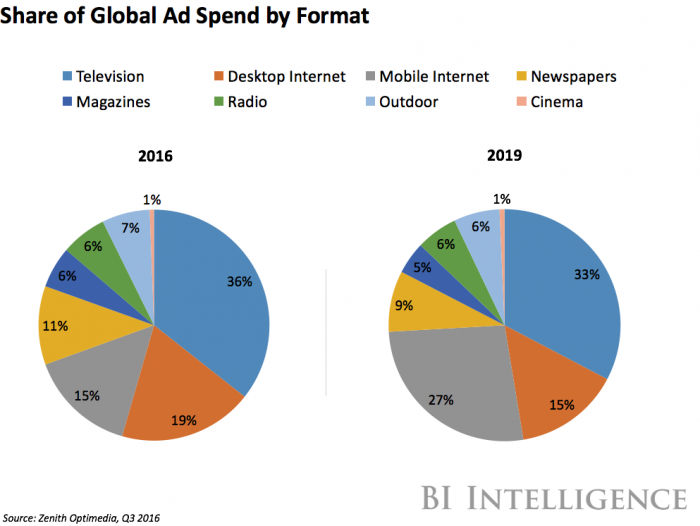
The media buying arms of the world’s largest advertising holding companies have released their ad spend forecasts for the coming year.
Variety reported on the estimates from WPP’s GroupM and Interpublic Group’s Magna Global, while Reuters outlined the forecast from Publicis-owned Zenith Optimedia.
Ad spend will increase in absolute terms, but year-on-year growth will slow:
- GroupM. Ad spend will grow 3.1% in 2016 but slow to 2.6% growth next year, driven by weaker US GDP growth and political uncertainty.
- Magna. Ad spend in the US will grow 6.9% in 2016, before slowing to just 1.7% growth next year, with TV ad revenue dipping.
- Zenith. This company expects ad spend growth to stay flat next year. Global ad spend will rise 4.4% in 2016 and continue to grow at this pace in 2017.
Political uncertainty and the lack of large events will drive this slowdown. The incoming Trump administration and the European situation are the prime drivers of political uncertainty. Meanwhile, the absence of ad-catalyzing events like the Rio Olympics, the US presidential election, Britain’s EU referendum, and the Euro soccer tournament will also limit growth.
Digital formats will continue to grow impressively as legacy formats straggle:
- GroupM. Digital media is forecast to account for one-third of ad spend next year. For every ad dollar spent in 2017, digital capture 77 cents, compared with 17 cents for TV. This year, digital captured 72 cents of every ad dollar, and TV captured 21 cents.
- Magna. Digital ads will be the top media category next year, reaching $202 billion and a market share of 40%, compared with linear TV ad sales, which are expected to reach $186 billion and capture 36% of the market. Digital’s share of the ad market will rise to 50% by 2021, or $299 billion, compared with 33%, or $195 billion, for TV, according to Magna.
- Zenith. Global ad spend on social media will reach $50 billion by 2019, accounting for 20% of all internet ad spend. Online video, meanwhile, is expected to reach $35.4 billion worldwide in 2019. By 2020, social media spend will comfortably overtake newspapers, and online video will marginally surpass radio but still lag TV.
Consumers continue to increase their time spent consuming digital media, while advertisers continue to increase their ad budgets into digital channels.
The influx is not expected to let up in the near future. The US digital advertising industry will continue to experience remarkable growth through 2021 to reach nearly $100 billion in annual revenue, driven primarily by the sustained migration of ad dollars from traditional TV to digital video and the continued increase of social spending.
Overall, the strong growth of the US digital ad market can largely be attributed to increased time spent by consumers on digital media and brands’ increased comfort with allocating budgets to digital formats, particularly on digital video. In a recent 2016 survey of almost 400 US ad agencies and marketers, the IAB found that two-thirds of respondents plan on increasing spending on digital video in the next year.
Moreover, mobile will become the top destination for digital ad spending as advertisers continue to attempt to resolve the disconnect between the rapid growth in time spent on phones and tablets and the relatively small share of ad budgets that are allocated to such platforms — known as the mobile opportunity gap. In fact, mobile is set to eclipse desktop ad spend by 2018.
Here are some key points:
- US digital ad revenue is expected to reach nearly $100 billion by 2021, according to analysts estimates. This represents compound annual growth of 8% from the $68.9 billion expected in 2016.
- Mobile is positioned to become the top destination for digital ad spending as advertisers continue to attempt to close the “mobile opportunity gap.”
- Digital video advertising will grow faster than any other segment over the next five years, as consumers shift time spent online to phones and tablets. Revenue in this category is forecast to rise from $8.5 billion in 2016 to $23 billion in 2021.
- Social advertising in all formats is gaining traction and will be among the key drivers of digital ad growth in the next five years. Social ad revenue is poised to climb to $30.8 billion by 2021, up from $15.5 billion this year.
- Artificial intelligence, augmented and virtual reality, and sponsored content will help propel further digital ad growth in the next decade.
as reported from the Business Insider.